Points, badges and leaderboards are the most visible part of gamification in education, and for adult learners they are the least reliable part. This article sets out what the research says, what backfires, and ten design rules for adult and vocational learning.
Three terms, three different things
People use these words as if they meant the same thing. They don't, and the evidence differs for each.
- Gamification adds game elements, such as goals, points, levels, badges, progress, a story, collaboration or competition, to a learning activity that is not a game.
- A serious game is a complete game designed for a purpose other than entertainment: training, awareness or a change in behaviour.
- A scenario-based simulation puts learners in a realistic situation where they decide, see the consequences and reflect. It may use game elements or none, and it can be text, video, 360° or VR.
For worked examples of the third kind, see our scenario-based learning examples.
What the research says works
On average, game elements give small to moderate learning gains, and well-designed games and simulations do better.
- Gamification. A meta-analysis by Sailer and Homner (2020) found small but significant effects on cognitive, motivational and behavioural outcomes. Only the effect on cognitive outcomes held up in the most rigorous studies, and a story (game fiction) and social interaction made a difference to behavioural outcomes. Bai, Hew and Huang (2020) found a moderate average effect across 24 studies with 3,202 participants, with design and context explaining much of the spread.
- Serious games. Wouters and colleagues (2013) found that serious games beat conventional instruction for learning and retention, but were not more motivating. Gains were larger when games were combined with other instruction, played over several sessions and played in groups. Clark and colleagues (2016) found that better-designed versions of the same game beat the standard versions: design matters as much as the choice of a game.
- Workforce training. Sitzmann (2011) found that learners trained with simulation games had higher self-efficacy, knowledge and retention than comparison groups, especially when learners were active, could replay as often as they wanted and used the game as part of wider instruction.
- Simulations for complex skills. In higher education, simulation-based learning had a large effect on complex skills, particularly with support such as prompts and reflection (Chernikova and colleagues, 2020).
What doesn't work, or backfires
- Points, badges and leaderboards on their own. In a semester-long study (Hanus and Fox, 2015), students in a course with badges and a leaderboard showed lower intrinsic motivation, satisfaction and sense of empowerment over time, and lower final exam scores linked to that drop in motivation.
- Rewards that control. Expected rewards tend to undermine intrinsic motivation, while feedback that informs can support it (Deci, Koestner and Ryan, 1999). For adults in mandatory training, a badge for "logged in five days" works like a controlling reward; feedback that explains what went well works like information.
- One-off events. A game played once, without other instruction, has smaller effects.
- Immersion without design. In one experiment, an immersive VR lab simulation gave a stronger sense of presence but less learning than the desktop version (Makransky and colleagues, 2019).
- Time pressure for its own sake. A clock adds stress and can exclude people with disabilities or low literacy. Keep it where time is the learning content, and offer an untimed practice mode.
Ten design rules for adult and vocational learning
- Start from the target behaviour and the learning outcome; choose the game mechanics last.
- Give every decision a visible, plausible consequence and feedback that explains why.
- Build in reflection and a debrief, and allow a retry with another approach.
- Plan for repetition: several short sessions, connected to other instruction.
- Prefer collaboration and story over competition. Use points and leaderboards only where competition serves the learning goal.
- Use progress and levels as information ("you can now handle this situation"), not as rewards that control.
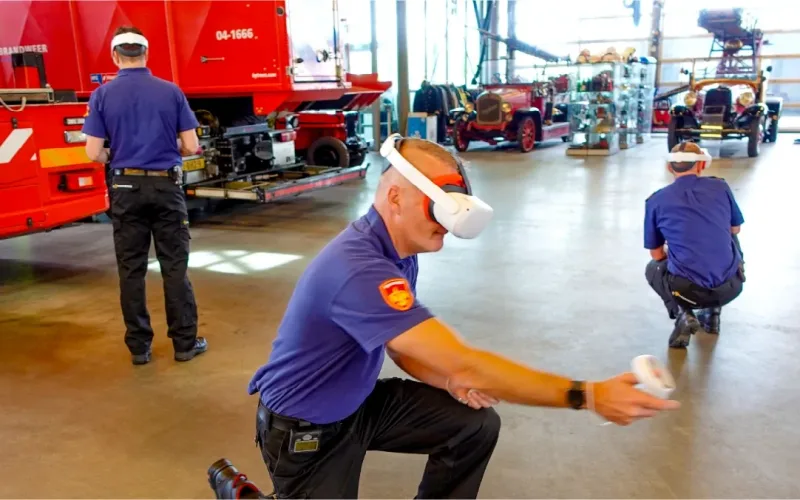
- Manage cognitive load, especially in VR: seated play, no artificial movement, a short pre-training and short scenes.
- Measure choices, not clicks, and only what the learning or the evaluation needs.
- Make it accessible by default: subtitles, voice-over, text alternatives, colour plus shape, untimed modes and plain language.
- If a badge or certificate is involved, tie it to assessed learning outcomes and a verifiable credential. We explain the steps in from badges to recognised learning.
If a game uses AI, for example for synthetic voices or hints, tell learners so, and keep decisions that affect a learner's progress with a person. AI that evaluates learning outcomes in education and vocational training institutions is high-risk under the EU AI Act, and the rules for it are set to apply from 2 August 2026. Our page on AI literacy and applied AI in learning sets out how we handle this.
Examples from our showcases
Our studio VR-Innovations works from the same idea: a game is a design, not a score. It starts from the behaviour people need to show, then builds a visible goal, choices with consequences and a way to measure what people actually do. For work training, points and a leaderboard are usually the weakest layer, used only where competition fits the goal. You can read how our studio builds serious games (in Dutch).
Three examples show the rules in practice:
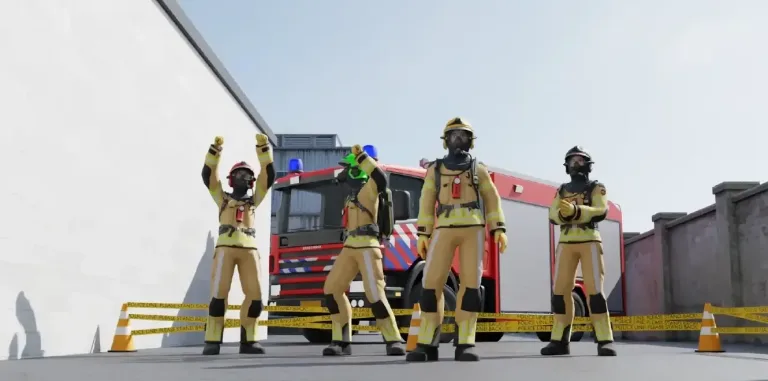
- Collaboration, with time as the content. In the IJsselland escape room, four firefighters play together and solve tasks against a 20-minute clock, the time of one breathing-air cylinder. Instructors follow the session on a tablet and can give hints.
- Feedback inside the story. In the Sterk Techniek Onderwijs VR game, pupils take a virtual computer apart and rebuild it, then help virtual customers who react with enthusiasm or frustration to the speed and quality of their help. The learners are secondary-school pupils rather than adults; we include the case for its feedback design.
- Feedback as information. In our first-response modules, learners giving chest compressions get direct feedback on rate and depth, and the module ends with a short quiz.
How we apply this in adult education and EU projects is described in serious games and gamification: design, not points. If you are weighing a serious game against a simpler gamified course, contact us and tell us what your learners need to practise.
Update, August 2026
In 2026 the EU amended the AI Act through the Digital Omnibus on AI, Regulation (EU) 2026/1744. The rules for high-risk AI in education and vocational training, including AI that evaluates learning outcomes, now apply from 2 December 2027.
One more reason to be careful: DigComp 3.0, the edition of the EU's digital competence framework published on 27 November 2025, lists gamification next to clickbait and nudging as a strategy that steers users, and asks people to recognise it. Gamified learning should therefore be open about what it does and serve the learning goal.