Adults learn a great deal by doing, and a well-built scenario lets them do it without real-world risk. Below are five scenario-based learning examples from our studio's work, followed by a practical guide to branching scenarios, feedback and measurement.
A two-sentence definition
Scenario-based learning puts learners in a realistic situation, asks them to make a decision and shows them the consequence. Feedback and reflection then turn that experience into something they can use at work.
When it works for adult learners, and when it doesn't
Scenarios work best when the goal is behaviour rather than recall: a difficult conversation, a judgement under pressure, a procedure that has to become routine. A meta-analysis of 145 studies in higher education found that simulation learning had a large effect on complex skills, especially with support such as examples, prompts, reflection or role-taking (Chernikova and colleagues, 2020). In workforce training, simulation games worked better when learners were active, could replay as often as they wanted and used the game alongside other instruction (Sitzmann, 2011).
Scenarios can also lower the reading load. In the OECD's 2023 Survey of Adult Skills, about 26% of adults in the participating countries had low literacy. Spoken, visual scenarios can reach learners whom text-heavy courses miss.
They work less well in three situations:
- Against other active methods. Sitzmann found no advantage over instruction that was just as active. A scenario is one good option, not the only one.
- As a one-off event. Gains are larger when a game is combined with other instruction and spread over several sessions (Wouters and colleagues, 2013).
- When immersion replaces design. In one experiment, an immersive VR lab simulation gave more sense of presence but less learning than the desktop version (Makransky and colleagues, 2019).
Five examples from practice
Each example below was built by our studio VR-Innovations. Not all of them are branching scenarios in the e-learning sense, but in each one learners practise in a realistic situation instead of reading about it.
1. Difficult conversations at an airport security lane
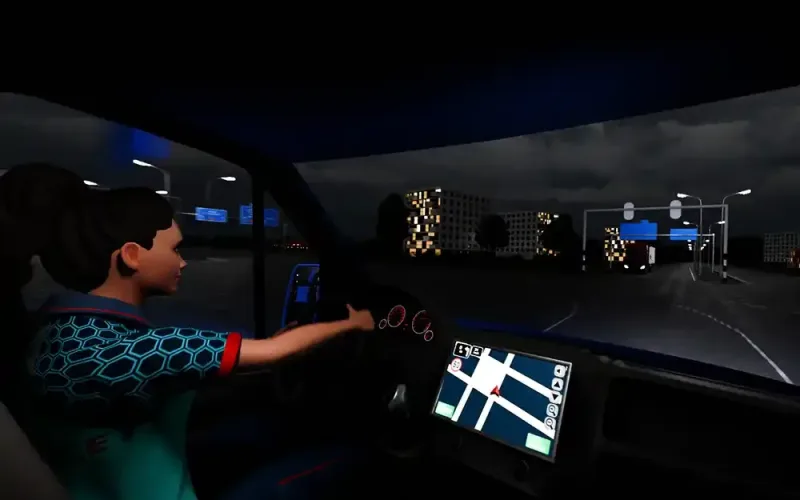
Security staff at Trigion Aviation Security choose one of four processes, from lane allocation to bag search, and then talk freely with a virtual passenger, without answer menus. The passenger reacts to the officer's approach, so a calm explanation, a clear boundary or a clumsy remark each lead somewhere different. Scenes include a wheelchair user and a passenger who does not speak the language. After a short reflection with feedback, the same scene starts again so the officer can try another approach. Read the Trigion VR role-play case.
2. Preparing non-native speakers for work, in their own language
INTOS asked for a VR training that prepares non-native speakers, including status holders and asylum seekers, for applying for jobs and working in the Netherlands. It is designed for people with limited Dutch, little digital experience and sometimes low literacy. In the INTOS job-readiness training, participants choose their language and a friendly robot guide explains and sums up. Modules cover applying for a job, exploring sectors such as logistics, hospitality, cleaning and care, and behaviour at work. There are no controllers to learn, and spoken explanation comes with subtitles. The training is designed to reduce tension and build confidence towards work.
3. Language and teamwork on the work floor
The VR training for Speak And Spoke has ten work situations, each starting in the middle of a communication problem: working together, giving feedback, safety or something unexpected. Learners speak aloud and choose what to say or do. An avatar called Maggy explains and gives feedback, and Tom, a talking dog, keeps the tone light. Making mistakes is allowed.
4. Team decisions against the clock
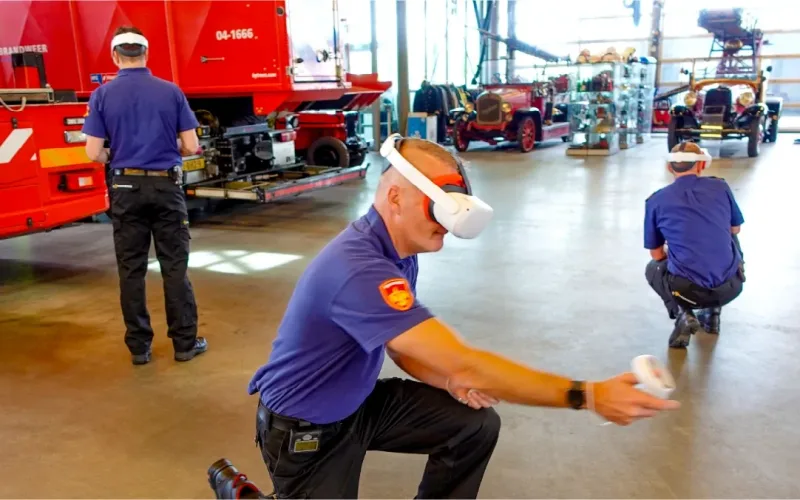
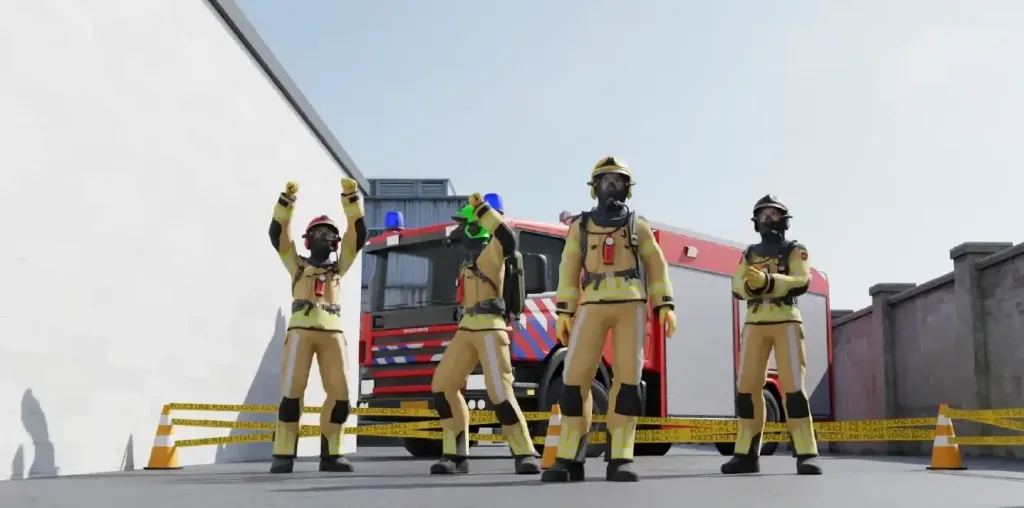
Veiligheidsregio IJsselland, a Dutch safety region, replaced an evening-long theory presentation for firefighters with the IJsselland multiplayer escape room, developed with Windesheim University of Applied Sciences. Four firefighters play at once, solving multiple-choice tasks, recognising icons and carrying out interventions. The clock is set to 20 minutes, the time of one breathing-air cylinder, and instructors use a tablet app to watch and give hints. Here, time pressure is part of what is being learned.
5. Short first-response modules with direct feedback
In our own first-response modules, a learner goes through a resuscitation from start to finish: check breathing, call 112, give chest compressions with direct feedback on rate and depth, then attach an AED. A short quiz closes the module. It is a tight practice loop: act, get feedback, act again.
Designing a branching scenario step by step
A branching scenario can run as scenario-based e-learning in a browser, as 360° video or in VR. The form follows the learning goal. These steps work for all of them.
- Start from the behaviour. Write down what people should do differently at work and the learning outcome that describes it. Choose game mechanics and technology last.
- Pick one real situation. Use a moment where people hesitate or get it wrong, and co-design it with subject experts and the target group.
- Map the decisions. Give each decision point a small set of options that a real person might choose.
- Write visible consequences. Every choice should lead to a plausible result, told in plain language, and where it helps on more than one dimension: for the learner, the team or the client.
- Keep the load light. Use short scenes and little text on screen. In VR, prefer seated play, avoid artificial movement and give a short pre-training.
- Make it accessible from the start. Add subtitles and voice-over, text alternatives, colour plus shape, an untimed practice mode and plain language.
- Pilot before you scale. Test the scenario with learners from the target group and adjust it.
If you are weighing a VR simulator against a VR training, our studio explains the difference in VR simulator or VR training? (in Dutch). For the design loop we follow and how it maps to EU competence frameworks, see how we design learning.
Feedback, reflection and retry
The decision is only half of the learning. What happens next matters as much.
- Explain why. Feedback that tells learners what went well, and why, can support their motivation, while rewards they come to expect tend to undermine it (Deci, Koestner and Ryan, 1999).
- Build in reflection. In the Trigion role-play a short reflection follows every scene. Reflection was among the support that made simulations more effective in the higher-education meta-analysis above.
- Let people try again. A retry with a different approach shows the effect of a choice straight away.
- Debrief together. Serious games gave larger gains when played in groups. An instructor who follows the session, as in the IJsselland escape room, can lead that conversation.
Measuring what learners do
A quiz checks what someone knows. A scenario shows what they do. That is why our studio records choices, time and progress per participant in its serious games, with a link to an LMS where needed.
Two cautions keep the data useful. Collect only what the learning or the evaluation needs, as GDPR data minimisation requires. And treat scenario data as formative evidence: the OECD notes that valid, reliable and fair game-based assessment is much harder and costlier to build than a conventional test, so it supplements standard assessment rather than replacing it.
If AI is used to evaluate learning outcomes in an education or vocational training institution, that use is high-risk under the EU AI Act. Under the Act as adopted in 2024, the rules for it apply from 2 August 2026.
Taking it into an Erasmus+ project
Scenario-based results can support several Erasmus+ priorities. The 2026 Programme Guide's digital transformation priority covers digital pedagogy, accessible and assistive technologies and digital education content, and the adult-education priorities include upskilling adults with low basic skills and more innovative teaching methods. Proposals are also assessed on how learning outcomes will be recognised and whether results are openly licensed.
In practice that means:
- co-designing the scenario with the target group and piloting it in each partner country;
- agreeing early which learning outcomes the scenario serves, so recognition can be planned;
- deciding who hosts and maintains the result after the project ends.
If your consortium is also thinking about points, badges or a full serious game, read gamification in education: what works for adults. If you want a partner to design and build the scenario-based result, you can partner with us. We contribute the digital learning parts; the application stays your consortium's own work, as the Programme Guide advises.
Update, August 2026
In 2026 the EU amended the AI Act through the Digital Omnibus on AI, Regulation (EU) 2026/1744. The rules for high-risk AI in education and vocational training, including AI that evaluates learning outcomes, now apply from 2 December 2027.