
Veiligheidsregio IJsselland: a multiplayer VR escape room for firefighters
Veiligheidsregio IJsselland (safety region)
View the showcaseVR serious game
Scenario-based learning puts learners in a realistic situation. They make a decision, see the consequence, reflect on it and try again. We design these scenarios for adults as serious games and as VR and AR simulations, and in simpler formats when that serves the learning goal better.
Our scenarios are built around one loop.
A recognisable moment from work or daily life. For example, a passenger at the airport security lane who is in a hurry and struggles with the instructions.
The learner acts: speaks, chooses or does something.
The situation responds. A calm explanation, a clear boundary or a clumsy reaction each sends the conversation in a different direction.
A short reflection with feedback, then the same scene again with another approach.
In branching scenarios, each decision opens a different path. What matters is what the learner notices, and what they do differently the next time.
Research on simulations and serious games points the same way, with conditions attached.
A meta-analysis of simulation games in workforce training found higher self-efficacy, knowledge and retention than in comparison groups. The effects were stronger when the game was active, could be replayed and was combined with other instruction, and there was no advantage over other active forms of instruction (Sitzmann, 2011).
A meta-analysis of simulation-based learning in higher education found a large effect on complex skills, and support such as examples, prompts and reflection added to it (Chernikova and colleagues, 2020).
Serious games did better than conventional instruction for learning and retention, but were not more motivating. Gains were larger over several sessions, in groups and alongside other teaching (Wouters and colleagues, 2013).
In one experiment, an immersive VR version of a lesson gave more sense of presence but less learning than the desktop version (Makransky and colleagues, 2019).
So we design for practice, replay and reflection, and we fit scenarios into a wider learning programme. These are findings from published research, not results of our own projects.
Insight Scenario-based learning examples
We choose the format after the learning goal. A scenario can run in a browser, on a tablet, in a headset or on a shared screen. VR in education and training is one option, not the default.
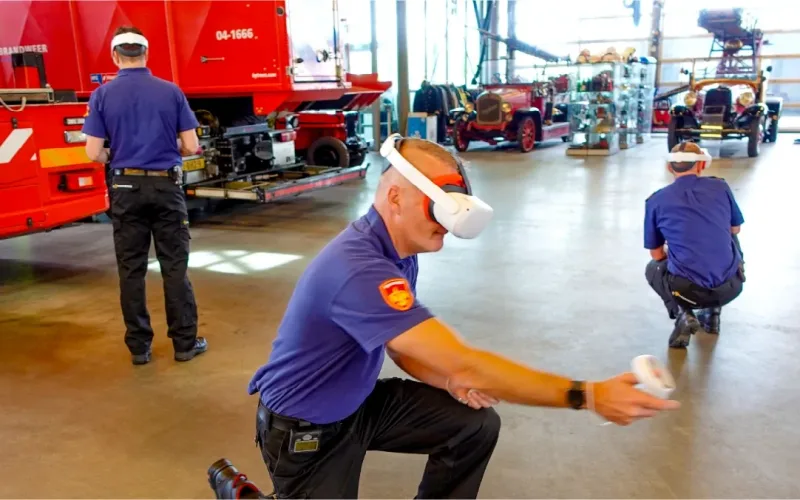
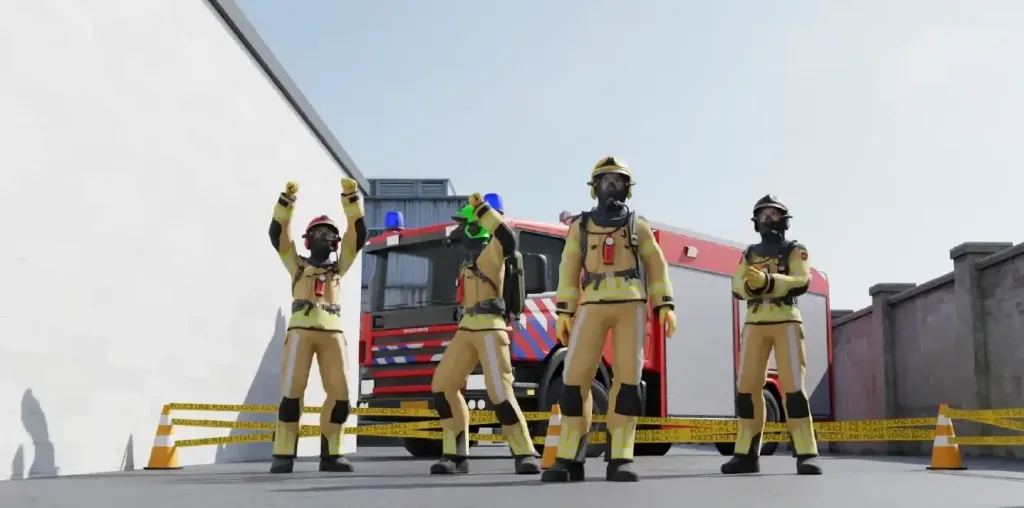
Four firefighters solve tasks together, under time pressure, in a multiplayer VR escape room for firefighters, developed for Veiligheidsregio IJsselland together with Hogeschool Windesheim.
In a VR game for technical education, pupils assemble a virtual computer, then help virtual customers who react to the speed and quality of their help.
Our first-response training in VR covers resuscitation with an AED, a fire extinguisher, a smoke-filled room and an escape route. During resuscitation, learners get direct feedback on the rate and depth of their chest compressions.
In language practice with guide avatars, learners work through ten work situations. One avatar explains and gives feedback; a talking dog keeps it light.
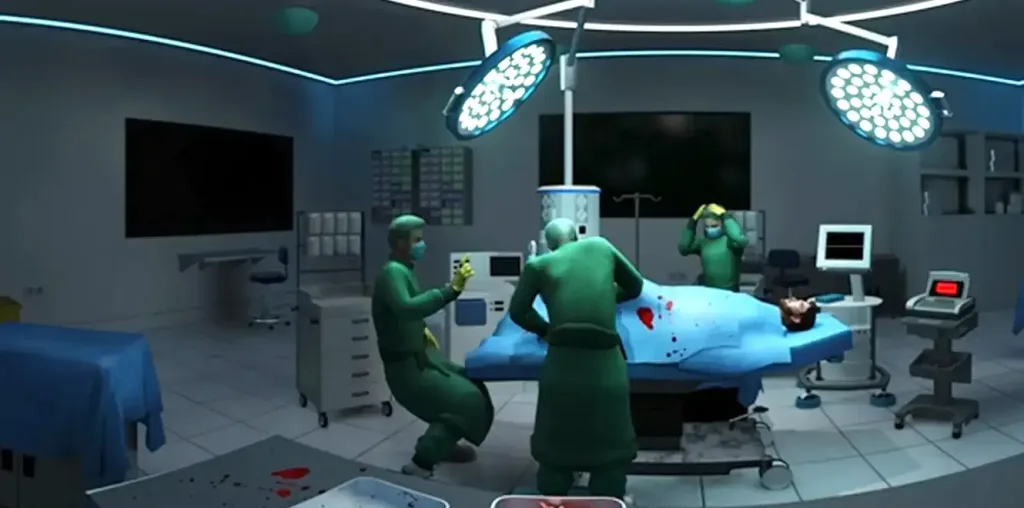
A delirium experience in VR of five to ten minutes lets doctors, students, informal carers and family see the world through the eyes of a patient with delirium.
We also build AR games on a tablet and interactive 360° video controlled by gaze, for example for events and heritage sites.
Gamification adds game elements, such as goals, levels, badges or a story, to a learning activity. A serious game is a complete game made for a purpose other than entertainment. Both can support game-based learning for adults; neither works through points alone.
What we use game mechanics for:
What we avoid:
In practice. Firefighters play against a 20-minute clock, the time of one breathing-air cylinder, while an instructor follows on a tablet app, gives hints and resets items. Here the time pressure is the learning content. Security staff replay a scene with another approach. Learners in first-response modules get direct feedback on their chest compressions.
Gamification in training works when it is part of the learning design, not a layer on top. We explain the evidence in gamification in education: what works for adults.
For commissioned games in the Netherlands and Flanders, see commercial serious game development in the Netherlands and Flanders (in Dutch) at our studio VR-Innovations.
A badge in a game shows that someone did something in the game. It becomes recognised learning only when it is tied to a described learning outcome and to evidence.
We can design the assessment points and the evidence export. Awarding and issuing the credential stays with the awarding organisation in the consortium.
This matters in Erasmus+: where a cooperation partnership plans learning activities, the award criteria look at how participants' learning outcomes will be recognised and validated.
The path from a game badge to a credential that others can check:
We use AI in scenarios only where it serves the learning goal, and we say what it does.
Synthetic voices for multilingual narration, clearly labelled; first drafts of translations, checked by a native speaker; hints; and analysis of learners' choices.
Any assessment that affects a learner's progress. Under the EU AI Act, AI that evaluates learning outcomes in education and vocational training institutions is a high-risk use, with the rules applying from 2 December 2027. AI that infers the emotions of people in education or at work is prohibited, except for medical or safety reasons.
Last checked: 12 November 2026. This is not legal advice. More on our approach in AI literacy and applied AI in learning.
In a European project, a scenario-based result should work for learners in several countries and stay available after the project ends.
We can bring:
A well-designed scenario supports three Erasmus+ arguments at once: a new way of teaching, inclusion through low-text and multimodal practice, and digital transformation.
How we plan and deliver this inside a consortium is described under EU project management.
Framework fit. Scenario-based practice maps mainly to the social competences of LifeComp: empathy, communication and collaboration. Where a scenario is about digital skills or AI, it also maps to DigComp 3.0. Read how our work maps to EU competence frameworks.
The design rules we apply to new scenarios:
You can see these choices in our cases: learners who start in their own language and work without controllers, a job preview that uses only the hands, and a heritage tour controlled by gaze.
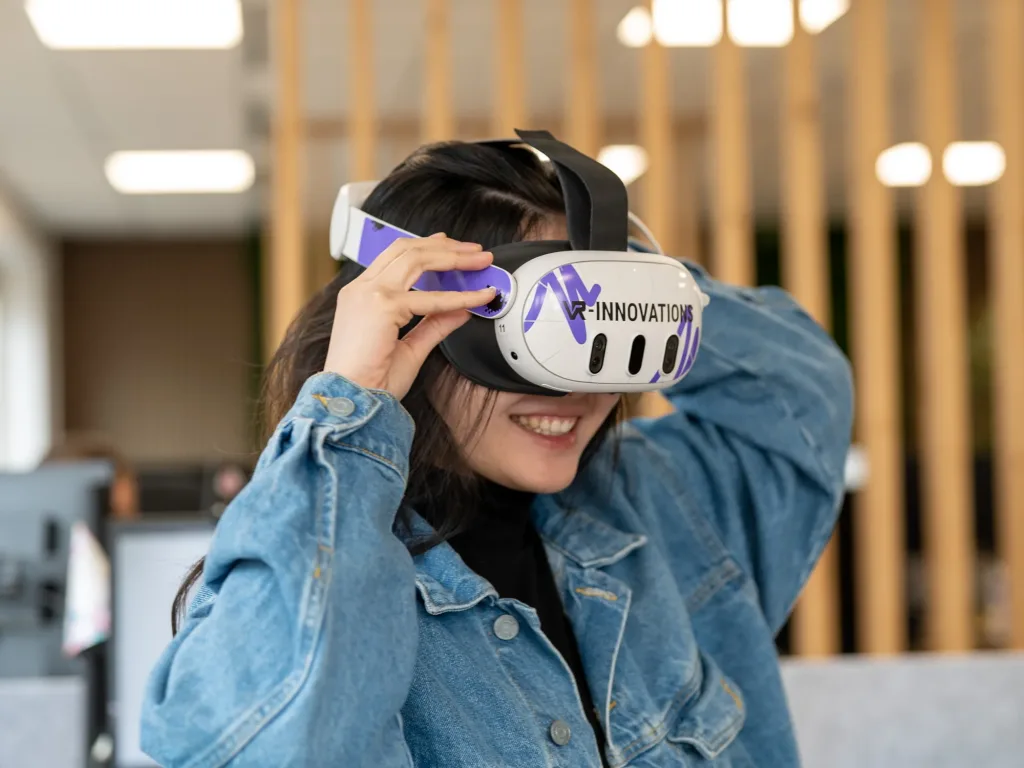
Scenario-based projects from our studio, from team training for firefighters to an empathy experience about delirium. Each case shows the learners, the scenario design and how it is delivered.
Veiligheidsregio IJsselland (safety region)
View the showcaseVR serious game
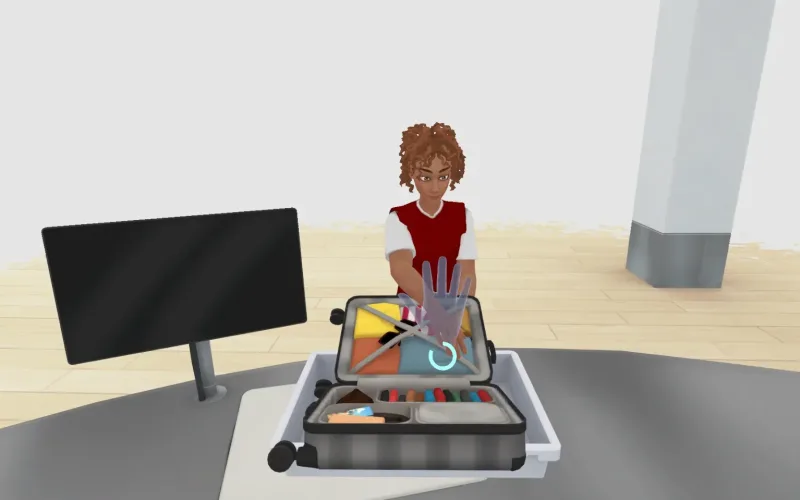
Trigion Aviation Security
View the showcaseScenario-based VR training
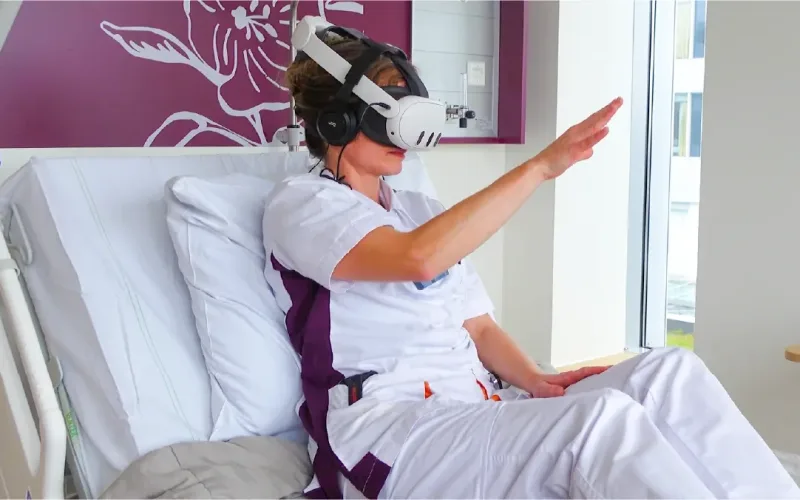
Santeon, a partnership of seven hospitals
View the showcaseVR experience
All cases, filterable by sector, are in our immersive learning case studies. Have a similar idea for your organisation or consortium? Talk to us about a scenario-based project.
Dutch organisations that want to commission VR training can go straight to our studio: VR training for Dutch organisations (in Dutch).
Gamification adds game elements, such as goals, levels or badges, to a learning activity that is not a game. A serious game is a complete game designed for learning, training or behaviour change. A branching scenario can use game elements, but does not need to.
Not on their own. In a semester-long classroom study, a course with badges and a leaderboard led to lower intrinsic motivation over time (Hanus and Fox, 2015). Feedback that explains what went well tends to support motivation; expected tangible rewards tend to undermine it (Deci, Koestner and Ryan, 1999).
Game data shows what learners do: their choices, their order and where they hesitate. Valid, reliable and fair game-based assessment is much harder and more costly to build than a conventional test, so we treat game data as formative evidence unless an assessment has been properly validated.
No. We choose the format after the learning goal: a browser, a tablet, a headset or a shared screen. When we use VR, the headsets can be set up and delivered ready to use.
We agree per project what is recorded and keep it to what the learning or the evaluation needs, for example choices, time and progress per participant. Results can go to the organisation's own environment in our portal, or to its learning management system.
Yes, if it is tied to a described learning outcome, an assessment point and recorded evidence, and is issued by an awarding organisation as a verifiable credential. The game alone does not award a recognised certificate.
Tell us about your learners, your call and the result your consortium needs to deliver.